Rebuilding the Best Music Discovery Tool That Ever Existed
Musicovery was the best music discovery tool ever made. It closed in 2017. I'm rebuilding the idea inside my own AI agent — and using my Spotify history to tune its personality while I'm at it.


There was a website called Musicovery.
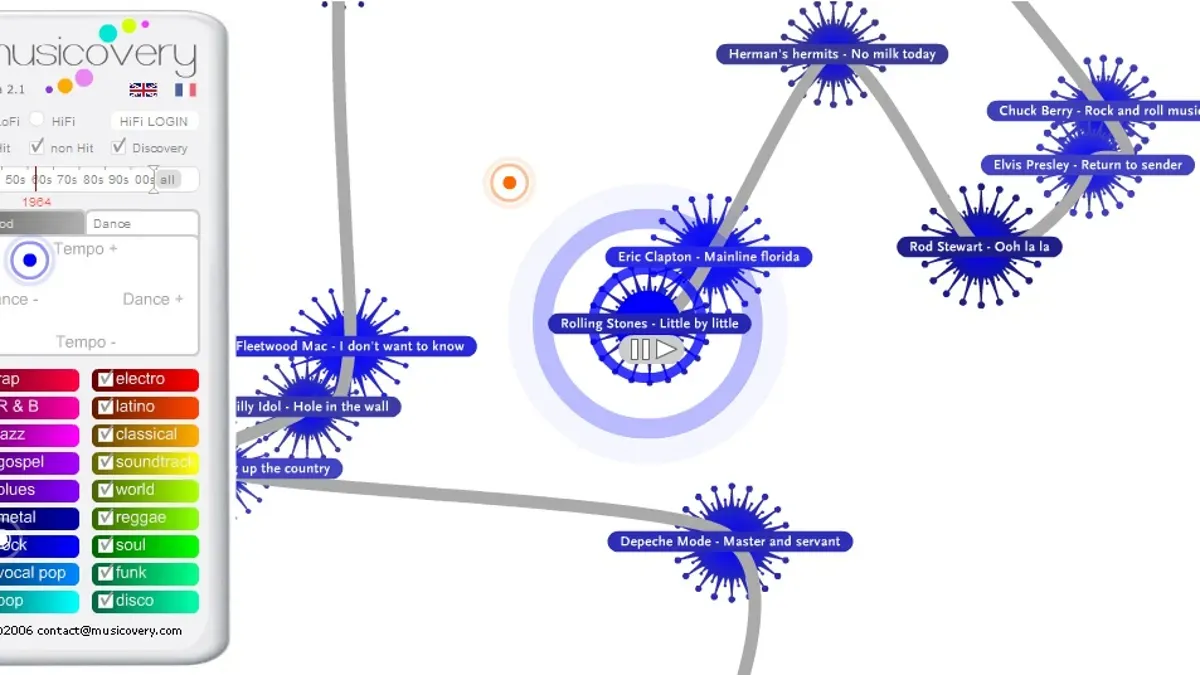
It had a simple interface: a 2D grid (for mood or dance). I used the Mood view. X-axis was energy — slow to fast. Y-axis was mood — sad to happy. You clicked somewhere on that grid, picked some genres and a couple of decades, and it handed you music.
Not a playlist. A web. Songs connected to other songs — colour-coded by genre, positioned by feel. You could traverse it — follow a thread from one track to the next, discover things you'd never have found otherwise, understand why two songs that sound nothing alike are actually neighbours. The Washington Post called it out for "segueing from a West Coast R&B band to a folk–rock group from Algeria." That's exactly the kind of jump that makes you love music again.
It was built by two French programmers who spent three years researching music description and human acoustic perception. Each track was mapped across 40 musical parameters.
One of them, Frédéric Vavrille, also made Liveplasma — a graphical artist discovery engine that's still alive today. You search an artist and it renders a constellation of related ones, sized by similarity. It's narrower than Musicovery was — no mood grid, no decade filter — but if you want to see the DNA of the idea, it's there. Worth a poke around.
They launched in 2006. JWT put them on their "80 things to watch in 2008" list. They closed the public service in January 2017 with a note that just said: "We hope you enjoyed the trip."
It was brilliant. It's gone. I think about it more than I should.
Spotify Radio Isn't Enough
Spotify has radio. It's fine. You seed it with a song or an artist and it picks similar stuff. But you can't really steer it. There's no "I want something like this but sadder" or "same vibe, different decade." You're just along for the ride.
What I want is control. Not full control — that defeats the point of discovery — but a dial. A sense that I can push the experience somewhere.
So I Started Building It
I've been hacking on a personal AI tool called Otto— it's a thing I built on top of the Zapier SDK where I can wire up tools, automations, and APIs and talk to them through an AI agent. Think of it as my own personal assistant that I've given access to most of the services I use.
I already have a set of Spotify tools running in it:
get-now-playing— what's currently onget-adjacent— find tracks adjacent in mood, tempo, and energy to a seed track. Filter by decade.search-tracks+play-track— search and immediately playadd-to-queue— stack things upget-devices— pick where it plays
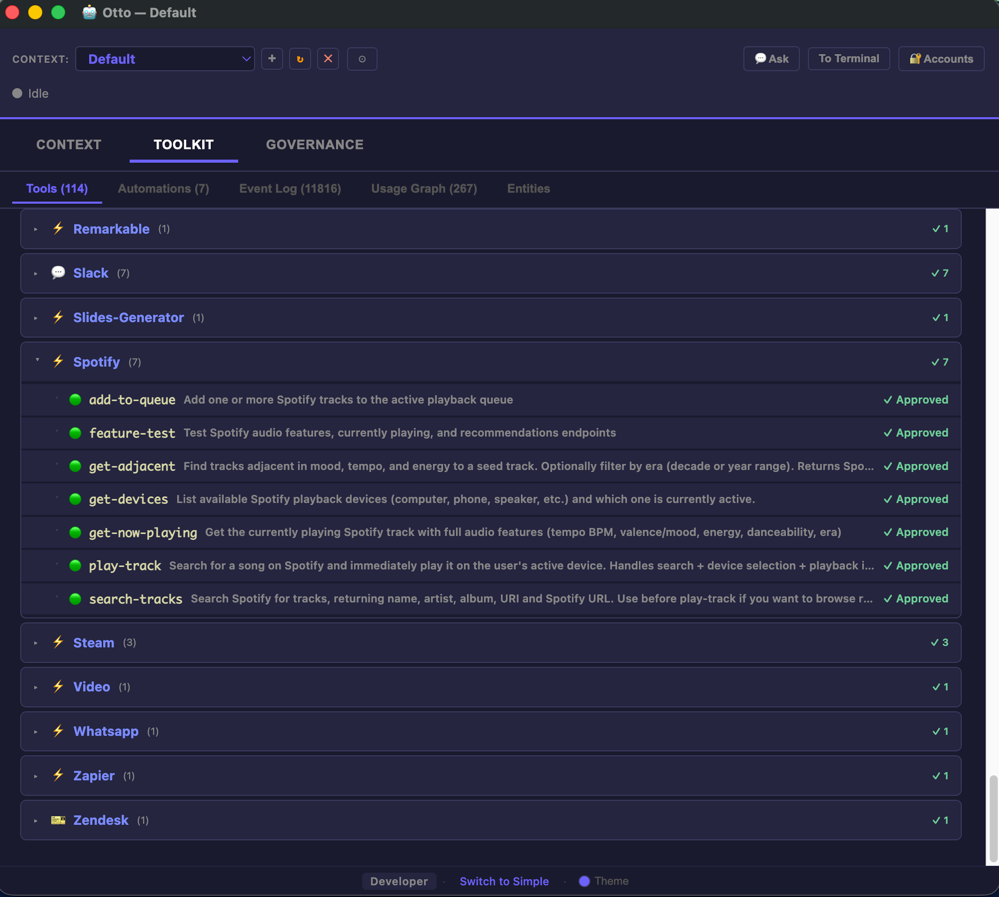
The get-adjacent tool is the important one. It uses Spotify's audio features API — valence (mood), energy, tempo, danceability — and finds tracks that sit nearby in that space. That's the grid. That's Musicovery.
Right now it works as a conversation: "find me something like this but slower and more melancholy, 90s preferably." It does it. It's actually good.
The next step is making it more of a traversable surface — something visual, something you can navigate without typing.
The Weird Part I'm Also Thinking About
Here's the bit fueling part of the journey...
Spotify knows me. It has years of my listening history — what I play when I'm working, what I put on late at night, what I skip, what I replay. That's a surprisingly complete picture of a person's inner weather.
So: what if Otto used that to adjust its own personality?
Not in a creepy way. Just — if I've been listening to a lot of slow melancholy stuff for three days, maybe the agent picks up on that and tones things down a bit. Matches the energy. Doesn't open with enthusiasm when I'm clearly not in an enthusiastic place.
The base personality stays the same. But the vibe tracks yours. An AI that reads the room using your Spotify history as a proxy for your current state.
Is this useful? Maybe. Is it a fun thing to build? Absolutely.
Where This Is Going
- Extend
get-adjacentinto a proper traversable graph — maybe a small web UI - Build the mood/energy grid as an input surface
- Pull listening history and run a "current vibe" summary on a schedule
- Feed that summary into the agent's system prompt as soft context
It's a hobby project. It'll take as long as it takes. But the Spotify tools already work and get-adjacent is genuinely useful today — I use it to unstick myself when I don't know what I want to listen to.
That alone was worth it.